The Meeting Architecture Problem: Why Organizations Spend Time Collectively Without Deciding Anything Collectively
When organizations design meetings around attendance and frequency rather than decision type and required output, they systematically convert collective time into collective cost with no structural return.
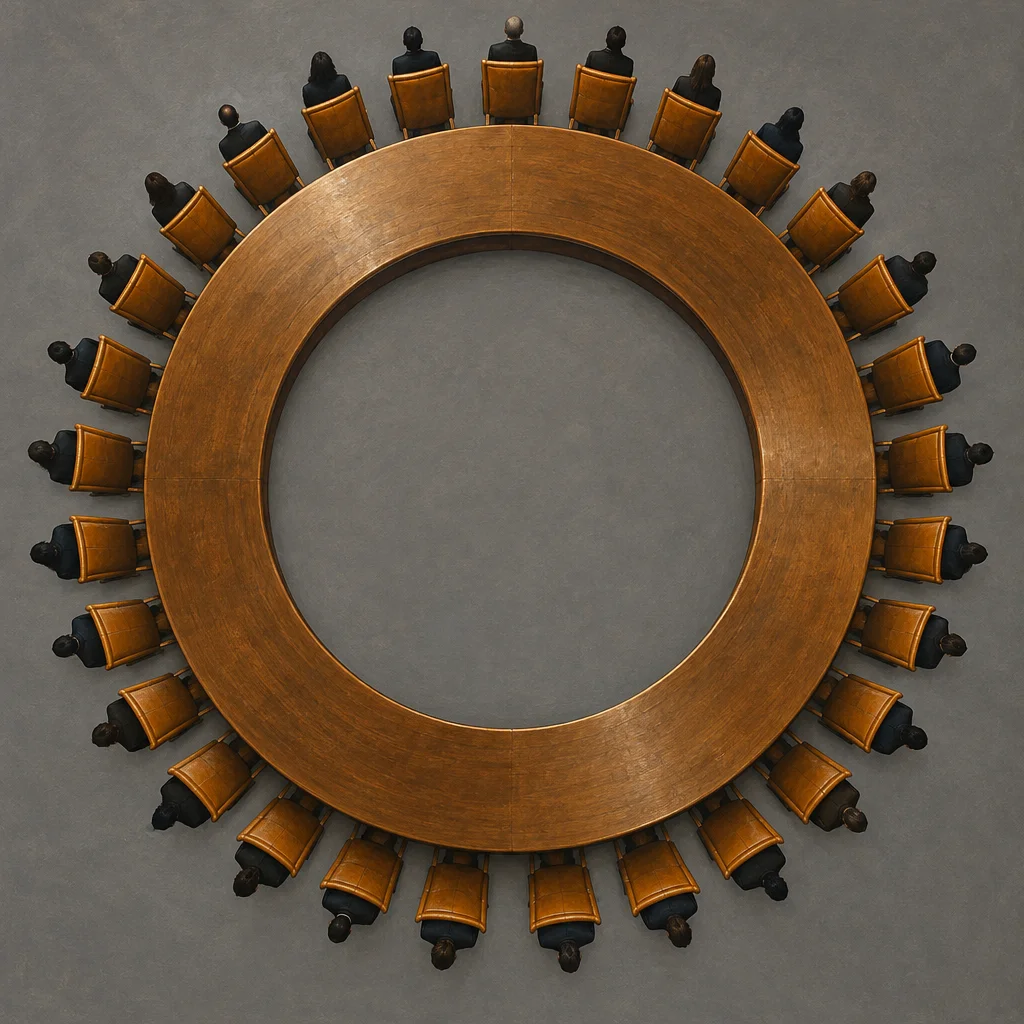
Most organizations have a meeting problem, but they tend to misdiagnose it. The common prescription is fewer meetings, shorter meetings, or more disciplined agendas. These are reasonable adjustments, and they produce modest relief. What they do not produce is a structural fix, because the underlying design flaw is not about volume or duration. It is about purpose architecture.
Meetings exist to accomplish one of a small number of things: generate shared understanding, make a decision, coordinate action, or maintain alignment over time. Each of these purposes requires a different structure, a different participant set, and a different definition of success. When organizations treat them as interchangeable, they create a single meeting format that is weakly suited to all four purposes and fully optimized for none.
The result is familiar. A director leaves a ninety-minute meeting uncertain whether a decision was made or merely discussed. A team spends forty minutes in a status update that could have been a written report, then rushes the last ten minutes on the item that actually required collective judgment. A cross-functional group assembles weekly to coordinate, but because no one owns the output, the coordination that happens is relational rather than structural. Each of these is a design failure, not a discipline failure.
Why the Distinction Matters More Than It Appears
When meeting purpose is undefined, several predictable things happen. First, preparation becomes impossible. Participants who do not know whether they are attending to contribute information, ratify a recommendation, or generate options cannot prepare appropriately for any of those things. They arrive in a neutral posture that is useful for none of them.
Second, the absence of defined output means success is unmeasurable. A meeting that ends without a decision is not obviously a failure if no decision was ever specified as the goal. This ambiguity protects bad meeting design from the scrutiny that would otherwise force improvement.
Third, and most consequentially for organizations at scale, undifferentiated meetings systematically dilute the authority of the people who should be deciding. When every meeting looks like a discussion and every discussion looks like a decision opportunity, actual decisions either get made informally before the meeting and ratified in it, or they get deferred until the next meeting where the same dynamic repeats. Neither path serves the organization.
A Working Taxonomy for Directors
The most practical intervention available to a director is to impose a simple taxonomy on the meetings they own and the meetings they attend. The specific categories matter less than the discipline of requiring that each meeting belong to one.
A reasonable starting taxonomy includes four types. A decision meeting exists to reach a conclusion on a specific, pre-specified question. Participants know the question in advance, relevant analysis arrives before the meeting, and the meeting ends with a documented decision and owner. A review meeting exists to assess progress against a defined standard and identify what, if anything, requires a response. It is not a progress report; it is a comparison between what was expected and what is true. A generative meeting exists to produce options, framings, or approaches that do not yet exist. It is structurally incompatible with time pressure and should not be scheduled when a decision is already overdue. A coordination meeting exists to surface dependencies, sequence work, and confirm that parallel tracks remain aligned. Its output is updated shared awareness, not decisions.
Declaring a type does two useful things simultaneously. It creates a checklist for preparation, because each type has different pre-work requirements. And it creates an evaluative standard for the meeting itself, because participants can recognize when a meeting is drifting from its declared type and name that drift explicitly.
The Participant Design Problem
Meeting type also governs who should attend, which is where most organizations make their most expensive errors. Decision meetings require the people with authority and the people with the most relevant information. They rarely require everyone who will be affected by the outcome. Coordination meetings require the owners of the interdependent workstreams. They do not require their managers. Generative meetings benefit from heterogeneous perspectives and suffer from hierarchical dynamics that make disagreement costly.
When participant lists are built by role, status, or political expectation rather than by what the meeting type actually requires, the cost compounds in both directions. People who should be there are sometimes absent, and decisions get made on incomplete information. People who should not be there are often present, and the dynamic adjusts to their presence in ways that reshape the output.
A director who does not control who attends a meeting cannot fully control what the meeting produces. This is worth naming directly, because in organizations where meeting attendance is treated as an entitlement or a signal of inclusion, the participant design problem is structurally protected from correction. The first step is separating attendance from respect, and then building participant lists from the declared purpose outward.
The Cadence Question
Meeting frequency is a secondary variable, but it is not irrelevant. The most common mistake is setting cadence before purpose. A standing weekly meeting implies that the relevant purpose repeats on a weekly basis with roughly equal intensity. For coordination of fast-moving work, that assumption is often correct. For decisions, it is almost never correct. Decisions arise when they arise, and a weekly decision meeting will either accumulate non-urgent items until the calendar date, or it will be canceled repeatedly when nothing has reached decision-readiness.
Suggesting that organizations move toward purpose-triggered meetings rather than calendar-triggered ones is structurally sound, though it requires a modest infrastructure investment in communication norms. The precondition is that participants trust they will be assembled when something genuinely requires assembly, which in turn requires a demonstrated track record of not assembling them otherwise.
A Structural Audit Worth Running
Directors who want to assess the meeting architecture they have inherited can run a simple audit across a representative two-week period. For each recurring meeting, the audit asks four questions: What type of output was this meeting designed to produce? What output did it actually produce in the last three cycles? Who attended, and what was each participant's functional contribution to the declared purpose? What would be lost if this meeting were replaced by an asynchronous process for the same declared purpose?
The answers to that last question are often more instructive than the first three combined. Meetings that cannot survive the substitution test are meetings whose actual value is relational coordination that no one has named explicitly. That is not a reason to eliminate them. It is a reason to redesign them with their true purpose declared, so that the relational investment they represent is made intentionally rather than accidentally.
The organizations that use collective time well are not the ones that have eliminated meetings. They are the ones that have made the purpose of each meeting specific enough that failing to meet it is visible. That visibility is the design condition that everything else depends on.